Khanpari Tibba Trek: The Mountain I Kept Looking At

The moment I saw the rooftop café at Timberwolves, a hostel tucked away on Manu Temple Road in Old Manali, I knew that the high chair at the edge of the café was going to be MY SPOT.

From there, the entire valley opened up in front of me, with mountains stacked one behind another and the Rohtang ranges visible in the distance. I would sit there with tea, breakfast, my laptop, or sometimes absolutely nothing, and stare at the mountains.
It was perfect, and it was going to be mine.
For the rest of my stay, most of my mornings looked exactly like that. Except, of course, for the cold Manali air piercing through my face and clothes all the way to my bones — a technicality I tremendously enjoyed. But then the sun would come out, and somehow the whole valley would feel like it had been wrapped in a warm blanket on a very chilly night.
And somewhere in that view, there was a particular mountain that kept catching my attention. I would sit in that chair, stare at it, and think, It would be really great to be up there. Eventually, I decided I should probably stop looking at it and actually go.
Khanpari Tibba Trek Begins
A few weeks into my stay at Timberwolves, two friends and I decided to do the Khanpari Tibba trek.
Rani Sui is a high-altitude mountain lake in the Manali region, generally described as sitting around 12,500 feet above sea level, near the route below Khanpari Tibba. Khanpari Tibba itself rises to roughly 13,200 feet.
One of my friends was an experienced trekker and had completed an advanced mountaineering course, so all I had to do was follow his lead.
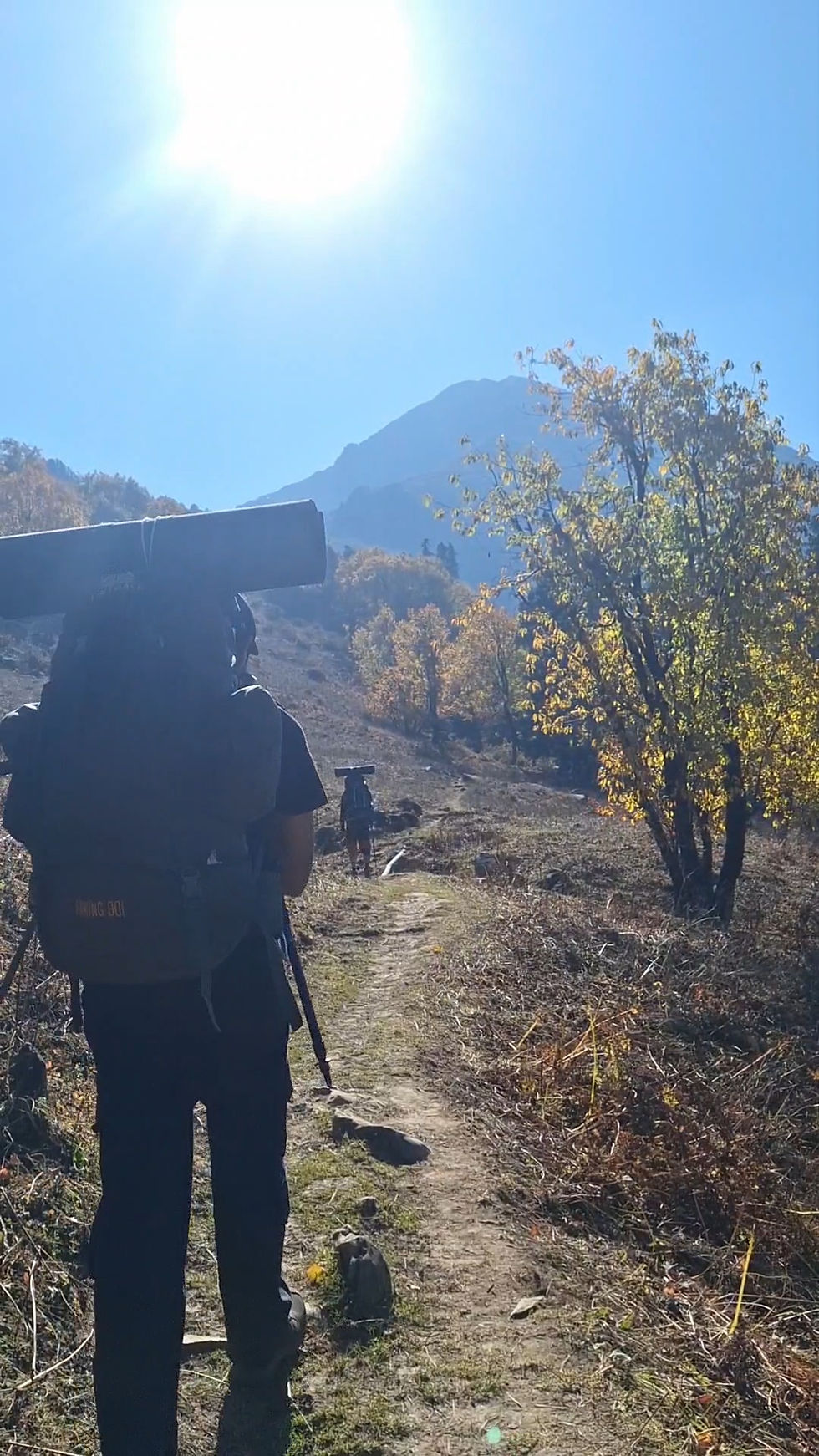
We woke up at the dawn of October 26th, had a light breakfast, and left for our journey.
A large part of the initial route passed through deodar forests. Some stretches were straightforward, while others forced us to stop and figure out exactly where we were supposed to go next.
At one point, fairly early in the trek, we came across an enormous rock sitting in the middle of the landscape. But when you climbed onto it, you could already see a large part of Manali below.
To clarify, I am not the quiet, meditative personality type. I talk. A lot. I was babbling away on the trail, and my friends and I were roasting each other as the trail allowed it.
Then came these sections where nobody had much to say because the climb gradually became a combination of almost everything you can imagine on a mountain trail: thick forest, open grassland, rocks, boulders, muddy patches, narrow sections, and very steep climbs.
The funny thing was that my quads and calves had quite a painful sensation initially, after which they stopped complaining as I dragged them for the first hour. My back, however, was ready to file a formal complaint.
You see, the rucksack was heavy with water, a tent, utensils, cooking equipment, and all the other things that suddenly become very important when you realise you’re going to spend a night or two on a mountain.
My friends were carrying even heavier bags, but it still felt like I had a small apartment strapped to my back. And that’s all it took to shut me up.
Lama Dugh
It took us roughly six hours to reach Lama Dugh, where we stopped for the night.
Lama Dugh is a high-altitude meadow and camping point above Manali, surrounded by forest and open mountain landscape. There was also a mountain stream of fresh water close by, where we stopped to refill our bottles.
After spending most of the day walking 10,000 feet up, carrying an apartment on my back, reaching our base and tearing open the first packet of Maggi felt like meeting god. We had rented a small Decathlon tent, and setting it up was surprisingly straightforward. We put it together and started cooking Maggi and ready-to-eat biryani on our portable camping stove.
A Night In The Mountains

One of the things I underestimated before the trek was the volatile temperatures at high altitudes.
During the day, the climb and the sun got me hot enough to question why I'd packed thermals. And then the sun disappeared. The temperature dropped dramatically. The cold at night wasn't the pleasant, mildly chilly Manali cold I had grown accustomed to. It was the kind of cold that could pierce through skin into your bones.
So if there's one practical thing I would tell anyone preparing for this kind of trek, it is this: Carry warm layers.
The Army Camp
After a while, a group of 20 army men arrived. They were travelling towards Bara Bhangal on a much longer, roughly twenty-day trek, so compared to us, they looked like they had packed half their lives. They had tents, food, cooking equipment, and a white goat. 20 army men trekking along with a pet goat was just the sweetest thing, I thought.
And then they got to work.
There was something almost mechanical about watching them work together. Nobody seemed to need to explain what needed to happen next. Before we had even properly registered what was happening, they had arranged a huge log of wood and started building a bonfire.
It was a completely unexpected little community for one night. People who had started the day as strangers were suddenly sitting around a bonfire together, eating, talking, singing, and sharing the same patch of mountain. We kept the music low because there was wildlife around and, well, the mountain doesn’t need us to turn it into a nightclub.
And then I saw it. The goat. And I remember thinking about buying meat from a supermarket, and how easy it is on our conscience to see meat as meat instead of witnessing the entire process from goat to meat. Pet goat I’d thought. Silly.
The Non-Negotiable
We woke up the next morning to see the army men leave, and also leave behind all their garbage. What happened next? The three of us cleaned up after them. It wasn't particularly glamorous. We simply collected what had been left behind and took it with us.
Note: When you travel through mountains, you must carry garbage bags and do your duty to leave the place looking like you were never there. The Himalayas aren’t a backdrop that exists for our photographs.
Khanpari Tibba
The next day, as we continued towards the top, my jar of regrets kept growing. The dense forest gradually gave way to much more open terrain. At one point, the landscape opened into a huge stretch of yellowish-golden grass that seemed to go on and on.
The sun was directly overhead, and yours truly had made the excellent decision of forgetting her cap and sunglasses. I was trekking, I was thirsty, I was carrying a rucksack that felt like it weighed 100 kilos, while the sun was personally attacking my eyes.

This was probably one of the worst parts of the trek for me physically. And yet, looking back, it was also one of the most beautiful landscapes we crossed. At that point, there wasn’t much left to do except keep climbing, complain occasionally, and hope the top was somewhere reasonably close.
And there it was! All of Manali.
We’d finally reached the top. Naturally, one of the first things I did when I got to the top was try to look for that chair at Timberwolves - the one I had been sitting in almost every day, staring at this exact mountain. It’s a slightly childish thing I do, I suppose. But where was that chair?
As I turned around to see the 360-degree view, it felt like I could just touch this part of the Great Himalayan Range. It was surreal.
For weeks, I had been sitting in that corner at Timberwolves, looking towards this mountain from below, and it was now underneath my feet. I was on top of the world even though it cost me two eyes and one spine to get there.
Comments